
Introduction
If you are involved in the tissue paper industry, you have probably come across the term tissue jumbo roll. Whether you are a tissue converter, distributor, brand owner, or importer, understanding what a tissue jumbo roll is and how it affects the quality of finished tissue products is essential for making informed purchasing decisions.
A tissue jumbo roll, also known as a parent roll, is the large roll of tissue paper produced directly on a paper machine before it is converted into finished products such as toilet paper, facial tissues, kitchen towels, napkins, and hand towels. The quality of the jumbo roll determines many key characteristics of the final product, including softness, strength, absorbency, appearance, and converting efficiency.
With a wide range of raw materials, basis weights, roll widths, and product specifications available, selecting the right tissue jumbo roll can be challenging. Different applications require different performance characteristics, and choosing the wrong specification may increase production costs or reduce product quality.
This guide explains everything you need to know about tissue jumbo rolls, including their manufacturing process, common types, technical specifications, raw materials, applications, and practical tips for choosing the right product for your business.
Table of Contents
1. What Is a Tissue Jumbo Roll?
2. How Are Tissue Jumbo Rolls Manufactured?
3. Types of Tissue Jumbo Rolls
4. Common Specifications
5.How to Choose the Right Tissue Jumbo Roll
6.Common Tissue Jumbo Roll Defects and How to Prevent Them
7.Frequently Asked Questions
1. What Is a Tissue Jumbo Roll?
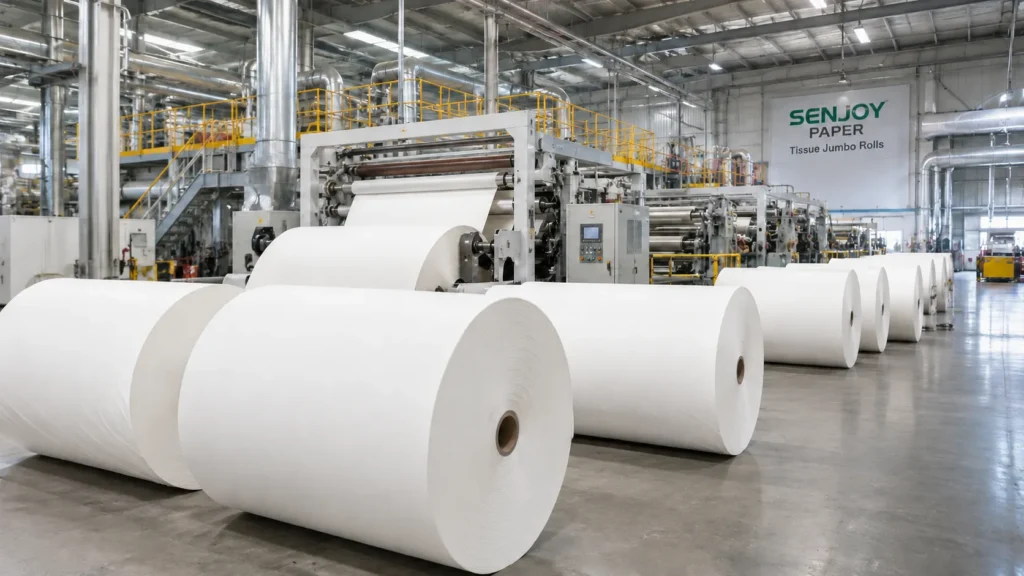
A tissue jumbo roll, also known as a parent roll, is a large roll of tissue paper produced directly on a tissue paper machine. It serves as the primary raw material for manufacturing a wide range of finished tissue products, including toilet paper, facial tissues, kitchen towels, napkins, hand towels, and many other consumer and commercial tissue products.
Unlike finished tissue products that are ready for end users, tissue jumbo rolls are designed specifically for tissue converters. During the converting process, these large rolls are rewound, embossed, laminated, perforated, printed, cut into smaller rolls or sheets, and packaged into products suitable for retail or commercial use. As a result, the quality of the tissue jumbo roll has a direct impact on the softness, strength, absorbency, appearance, and converting efficiency of the final product.
Tissue jumbo rolls are available in a wide range of specifications to meet different production requirements. Manufacturers and converters can select different basis weights (GSM), roll widths, roll diameters, core sizes, ply structures, and raw materials depending on the finished product they intend to produce. Choosing the appropriate specification is essential for ensuring efficient production and consistent product quality.
Although consumers rarely see a tissue jumbo roll, it plays a central role in the tissue paper manufacturing supply chain. It acts as the bridge between papermaking and finished tissue converting.
Where Does a Tissue Jumbo Roll Fit in the Production Process?
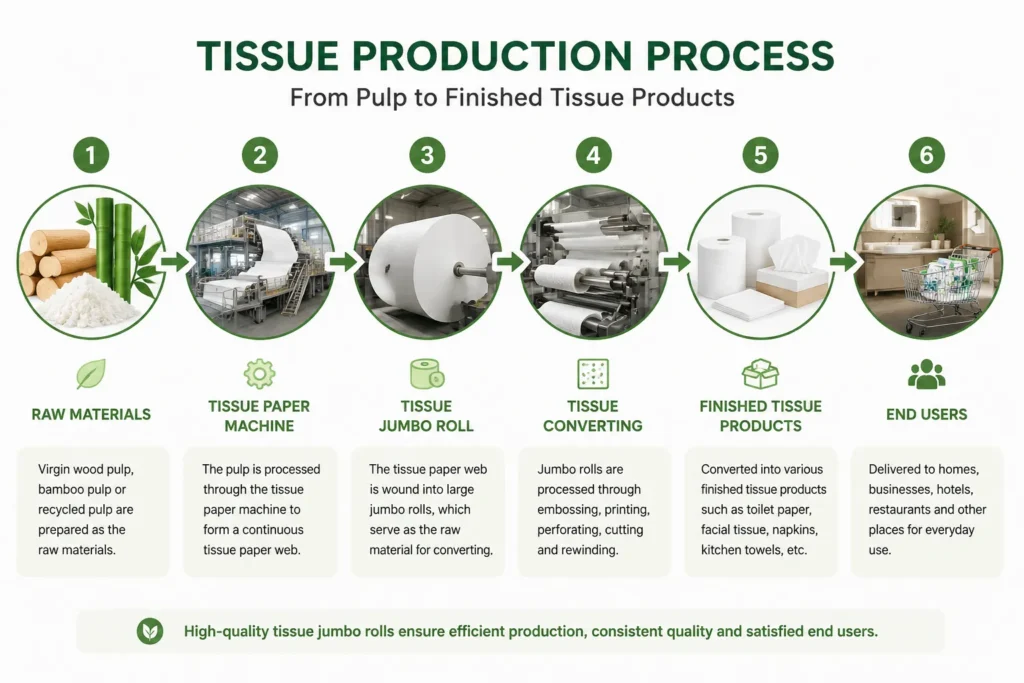
After the jumbo roll is produced, it is delivered to tissue converting facilities, where it is transformed into finished tissue products for households, hotels, restaurants, offices, hospitals, supermarkets, and many other applications. Without high-quality tissue jumbo rolls, converters cannot consistently produce high-quality finished products.
Tissue Jumbo Roll vs. Finished Tissue Products
| Feature | Tissue Jumbo Roll | Finished Tissue Products |
|---|---|---|
| Product Stage | Raw material | Consumer-ready product |
| Main Users | Tissue converters | Consumers, hotels, retailers |
| Packaging | Large industrial rolls | Retail or commercial packs |
| Processing | Requires converting | Ready to use |
| Typical Applications | Toilet paper, facial tissue, napkins, kitchen towels | Daily household and commercial use |
Understanding this distinction is particularly important for importers, distributors, and private label brands. Purchasing a tissue jumbo roll means buying the raw material for converting, while purchasing finished tissue products means buying products that are ready for immediate use or sale.
Why Is a Tissue Jumbo Roll So Important?
Although a tissue jumbo roll is never seen by the end consumer, it is one of the most important components in the tissue industry. Every characteristic of the finished product—including softness, absorbency, strength, appearance, and converting efficiency—begins with the quality of the jumbo roll.
For tissue converters and private label manufacturers, selecting the right tissue jumbo roll is not simply a purchasing decision. It directly influences production efficiency, material utilization, product consistency, manufacturing costs, and customer satisfaction. A well-manufactured jumbo roll can reduce production downtime, minimize waste, and help maintain stable product quality throughout the converting process.
Key Characteristics of a High-Quality Tissue Jumbo Roll
When evaluating tissue jumbo rolls, professional buyers typically pay attention to the following characteristics:
- Consistent basis weight (GSM)
- Excellent softness and absorbency
- Uniform roll winding
- Stable moisture content
- Good tensile strength
- Smooth converting performance
- Reliable raw material quality
- Consistent roll dimensions
These characteristics help ensure efficient converting operations and stable finished product quality, making them important considerations when selecting a tissue jumbo roll supplier.
💡 Buyer Tip
When comparing tissue jumbo rolls, avoid making your decision based on price alone. Factors such as basis weight consistency, raw material quality, roll winding performance, and machine compatibility often have a greater impact on production efficiency and the overall cost of manufacturing finished tissue products.
2. How Are Tissue Jumbo Rolls Manufactured?
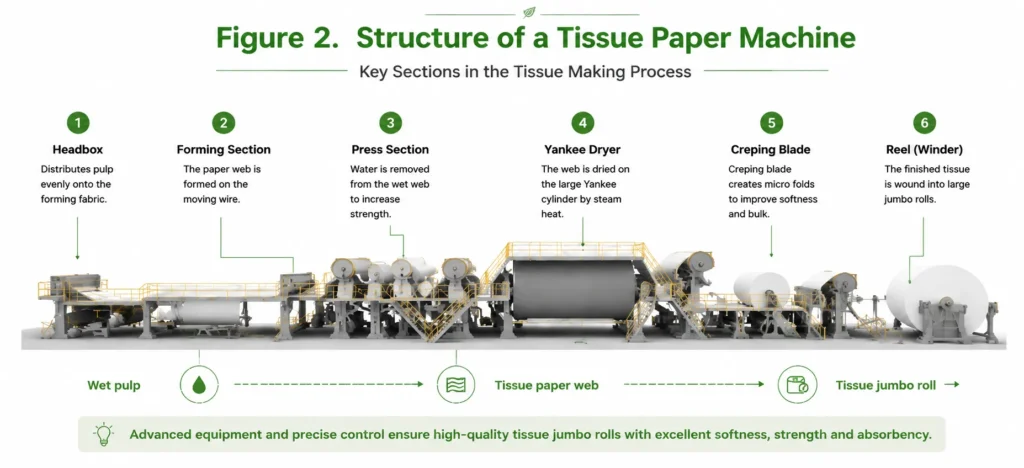
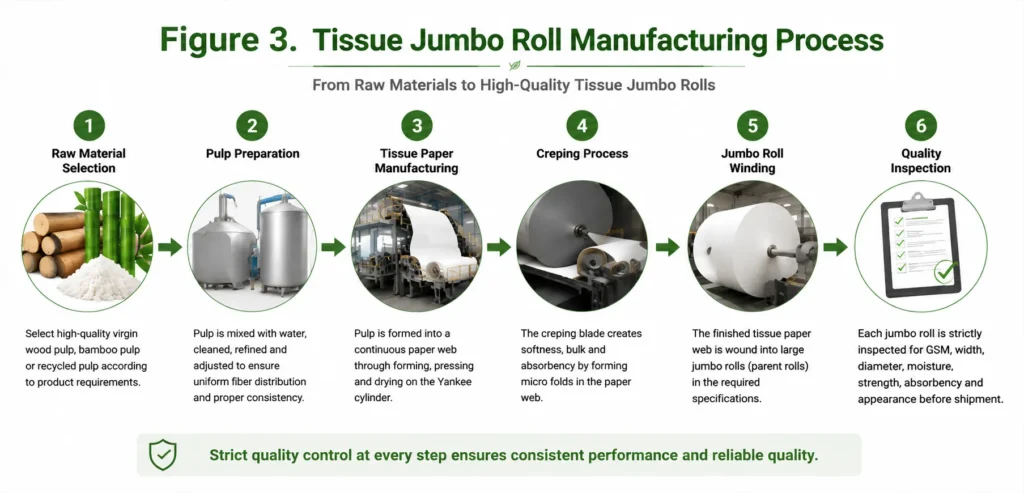
Every high-quality tissue jumbo roll begins with a carefully controlled manufacturing process. From raw material selection to the final winding of the parent roll, each production stage plays a crucial role in determining the softness, strength, absorbency, and converting performance of the finished tissue products.
Although different tissue mills may use different production technologies and equipment, the overall manufacturing process generally follows the same workflow.
1 Raw Material Selection
The manufacturing process starts with selecting the appropriate raw materials. The most common fiber sources include:
- Virgin Wood Pulp – Known for its excellent softness, strength, and brightness, making it ideal for premium tissue products.
- Bamboo Pulp – An increasingly popular sustainable alternative that offers natural softness and fast-growing renewability.
- Recycled Pulp – Commonly used for economical or industrial tissue products where cost efficiency is a priority.
- Sugarcane Pulp – A renewable, non-wood fiber made from sugarcane-processing residue. It offers good bulk and absorbency and is often used alone or blended with other fibers for tissue and sustainable paper products.
The choice of raw material directly influences the quality, appearance, and performance of the tissue jumbo roll.
2 Pulp Preparation
The selected pulp is mixed with water to create a uniform fiber suspension. During this stage, impurities are removed, and the pulp consistency is carefully adjusted to ensure even fiber distribution.
Proper pulp preparation helps improve paper formation, product consistency, and overall machine efficiency.
3 Tissue Paper Manufacturing
The prepared pulp is delivered to a tissue paper machine, where it is formed into a continuous paper web.
The paper passes through several production stages, including:
- Sheet forming
- Pressing
- Drying on a Yankee cylinder
- Creping
- Reeling
Among these processes, creping is particularly important because it creates the softness, bulk, and absorbency that tissue products are known for.
4 Jumbo Roll Winding
After drying and creping, the finished tissue paper web is wound into large tissue jumbo rolls, also known as parent rolls.
Depending on customer requirements, manufacturers can produce jumbo rolls in various specifications, including:
- Different basis weights (GSM)
- Roll widths
- Roll diameters
- Core sizes
- Ply structures
These jumbo rolls are then supplied to tissue converters for further processing.
5 Quality Inspection
Before shipment, every tissue jumbo roll should undergo comprehensive quality control inspections to ensure consistent performance.
Typical quality checks include:
- Basis weight (GSM)
- Roll width and diameter
- Moisture content
- Tensile strength
- Absorbency
- Roll winding quality
- Surface appearance
Strict quality control helps reduce converting waste, improve machine efficiency, and ensure consistent finished product quality.
Why Manufacturing Quality Matters
Even small differences in the manufacturing process can have a significant impact on the final tissue products. A well-manufactured tissue jumbo roll delivers better converting performance, higher production efficiency, and more consistent product quality.
For tissue converters, distributors, and private label brands, partnering with an experienced tissue jumbo roll manufacturer ensures a stable supply of high-quality raw materials and helps build reliable finished tissue products that meet market expectations.
💡 Buyer Tip
When evaluating a tissue jumbo roll supplier, don’t focus solely on price. Consistent GSM, stable winding quality, reliable raw materials, and strict quality control can significantly improve converting efficiency, reduce waste, and lower your overall production costs.
3.Types of Tissue Jumbo Rolls
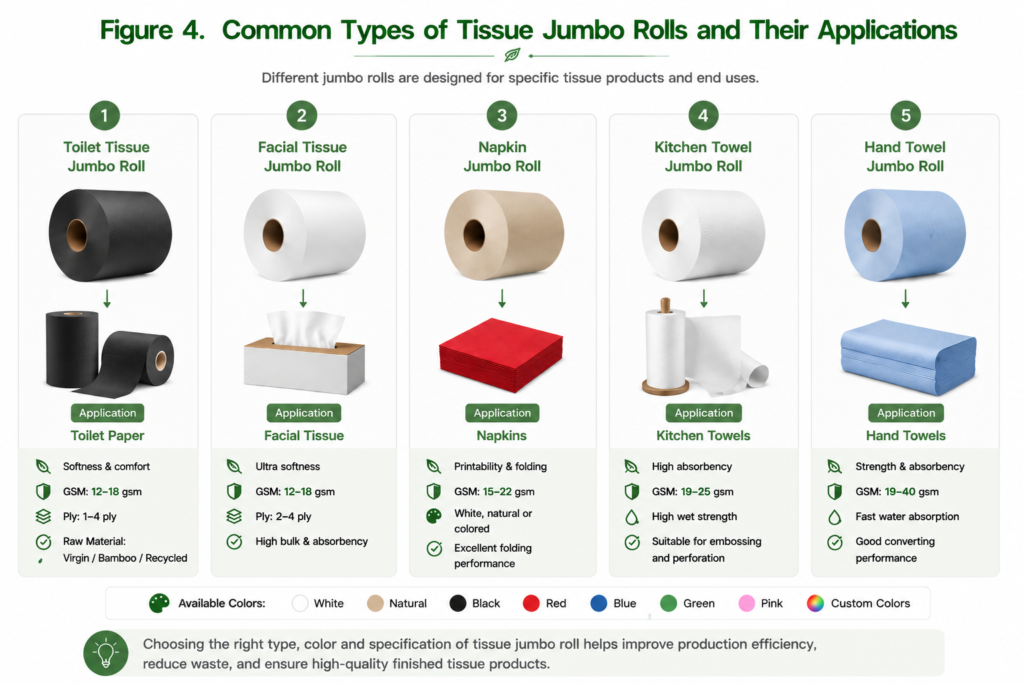
Not all tissue jumbo rolls are the same. They are designed for different finished tissue products and manufacturing requirements. Depending on the application, raw material, ply structure, embossing requirements, and converting process, tissue jumbo rolls can vary significantly in their specifications and performance.
Understanding the different types of tissue jumbo rolls helps buyers choose the right parent roll for their production line, reduce converting costs, and improve the quality of finished products.
The most common types include:
- Toilet Tissue Jumbo Rolls
- Facial Tissue Jumbo Rolls
- Kitchen Towel Jumbo Rolls
- Napkin Jumbo Rolls
- Hand Towel Jumbo Rolls
Toilet Tissue Jumbo Rolls
Toilet tissue jumbo rolls are designed for converting into household toilet paper and commercial toilet tissue. They are produced with excellent softness, tensile strength, and controlled absorbency to ensure smooth converting and consumer comfort.
Typical specifications include:
- GSM: 12–18 gsm
- Ply: 1–4 ply
- Raw materials: Virgin wood pulp, bamboo pulp, or recycled pulp
- Embossing: Suitable for embossed and laminated toilet tissue
- Applications: Household toilet paper, hotel tissue, institutional tissue, and commercial toilet rolls
Facial Tissue Jumbo Rolls
Facial tissue jumbo rolls are manufactured with higher softness and surface smoothness because facial tissues come into direct contact with the skin. They require excellent fiber quality and good formation to provide a premium user experience.
Typical specifications include:
- GSM: 13–18 gsm
- Ply: 2–4 ply
- High softness
- Excellent bulk and absorbency
- Applications: Box facial tissue, pocket tissue, soft packs, and premium facial tissues
Kitchen Towel Jumbo Rolls
Kitchen towel jumbo rolls are produced for high absorbency and wet strength. Compared with toilet tissue, kitchen towel paper generally has higher basis weight and stronger fiber bonding to withstand water and cleaning tasks.
Typical specifications include:
- GSM: 18–24 gsm
- Excellent water absorption
- High wet strength
- Suitable for embossing and perforation
- Applications: Household kitchen towels, industrial wiping paper, and cleaning towels
Napkin Jumbo Rolls
Napkin jumbo rolls are widely used for manufacturing cocktail napkins, luncheon napkins, dinner napkins, beverage napkins, and dispenser napkins. They are available in white, natural, and colored tissue paper for restaurants, hotels, airlines, cafés, and catering services.
Typical specifications include:
- GSM: 15–22 gsm
- White, natural, or colored tissue
- Excellent printability
- Good folding performance
- Applications: Food service, hospitality, retail, and catering industries
Hand Towel Jumbo Rolls
Hand towel jumbo rolls are designed for producing folded hand towels, center-pull towels, and hardwound towels used in commercial washrooms, hospitals, schools, and public facilities.
Typical specifications include:
- GSM: 18–24 gsm
- High strength
- Fast water absorption
- Good converting performance
- Applications: Commercial washrooms, healthcare facilities, offices, and public institutions
Comparison of Common Tissue Jumbo Roll Types
| Type | Main Feature | Typical GSM | Common Applications |
|---|---|---|---|
| Toilet Tissue Jumbo Roll | Softness & comfort | 12–18 gsm | Toilet paper |
| Facial Tissue Jumbo Roll | Ultra softness | 12–18 gsm | Facial tissue |
| Kitchen Towel Jumbo Roll | High absorbency | 19–25 gsm | Kitchen towels |
| Napkin Jumbo Roll | Printability & folding | 15–22 gsm | Napkins |
| Hand Towel Jumbo Roll | Strength & absorbency | 19–40 gsm | Hand towels |
4. Common Specifications of Tissue Jumbo Rolls
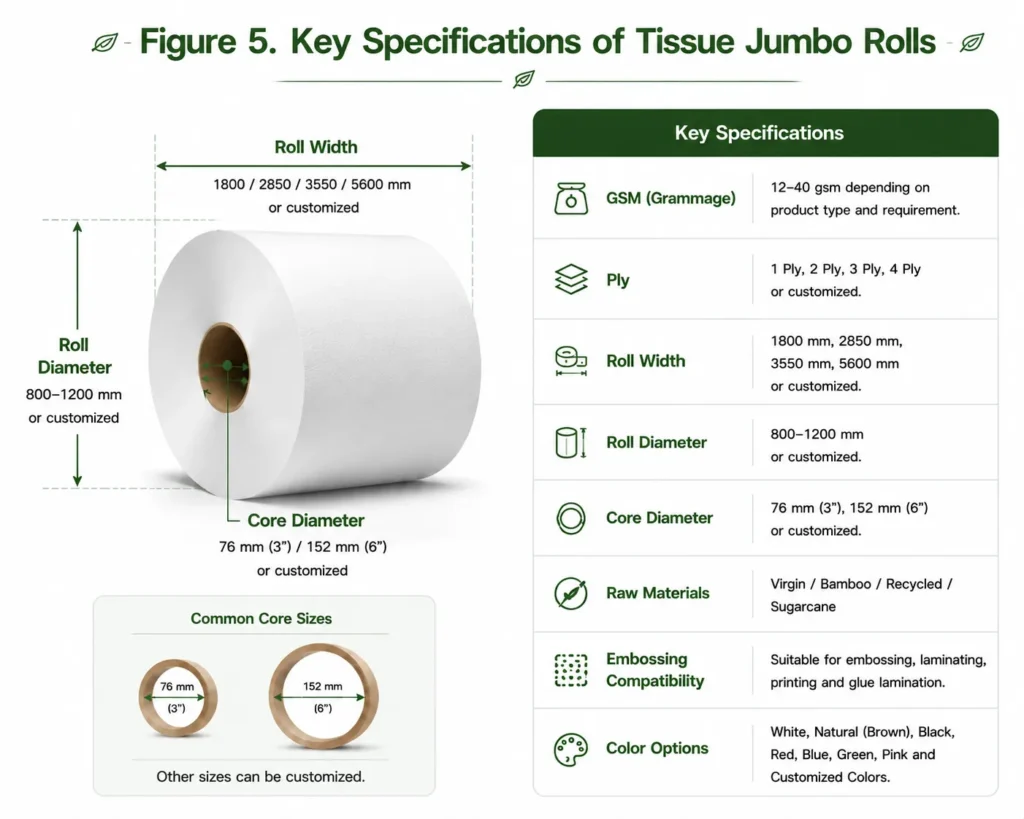
Before purchasing tissue jumbo rolls, buyers should understand the key specifications that directly affect converting efficiency, finished product quality, transportation costs, and production performance. The most important specifications include GSM, ply, roll width, roll diameter, core size, raw material, and embossing compatibility.
Although exact specifications vary depending on the intended application, most tissue jumbo rolls are evaluated based on the following parameters.
1. GSM (Grammage)
GSM (grams per square meter) refers to the weight of tissue paper. It is one of the most important specifications because it influences softness, strength, absorbency, and production cost.
Typical GSM ranges include:
| Product | Typical GSM |
|---|---|
| Toilet Tissue | 12–18 gsm |
| Facial Tissue | 12–18 gsm |
| Napkin | 15–22 gsm |
| Kitchen Towel | 19–25 gsm |
| Hand Towel | 19–40 gsm |
Choosing the appropriate GSM depends on the desired balance between product quality and manufacturing cost.
2. Ply
Ply indicates how many tissue layers are combined to produce the finished product.
Common options include:
- 1 Ply
- 2 Ply
- 3 Ply
- 4 Ply
Higher ply products generally provide better softness, absorbency, and bulk, while lower ply products offer better cost efficiency.
3. Roll Width
The jumbo roll width determines how efficiently converters can slit and rewind the paper into finished products.
Common widths include:
- 1600 mm
- 2850 mm
- 3550 mm
- 5600 mm
- Customized widths
Choosing the correct width helps reduce production waste and maximize machine efficiency.
4. Roll Diameter
Roll diameter directly affects production efficiency.
Larger diameters mean:
- Longer machine running time
- Fewer roll changes
- Lower labor costs
- Higher converting efficiency
Typical diameters range from:
800–1200 mm
depending on the machine configuration.
5. Core Size
The core is the cardboard tube located in the center of the jumbo roll.
Common core diameters include:
- 76 mm (3″)
- 152 mm (6″)
- Customized sizes
Selecting the correct core size ensures compatibility with converting equipment.
6. Raw Material
The raw material has a significant impact on softness, strength, absorbency, appearance, and sustainability.
Common options include:
- Virgin Wood Pulp
- Bamboo Pulp
- Recycled Pulp
- Sugarcane Pulp
- Mixed Fiber
Each material offers different advantages depending on the target market and product positioning.
7. Embossing Compatibility
Some tissue jumbo rolls are specifically designed for:
- Embossing
- Laminating
- Printing
- Glue lamination
- Point-to-point embossing
Good converting performance ensures stable production and higher-quality finished products.
8. Color Options
Besides traditional white tissue, many manufacturers also supply colored tissue jumbo rolls for premium hospitality and customized products.
Common colors include:
- White
- Natural (Brown)
- Black
- Red
- Blue
- Green
- Pink
- Customized Colors
Colored tissue jumbo rolls are widely used for restaurants, hotels, parties, premium napkins, and branded tissue products.
💡 Buyer Tip
When requesting a quotation, always specify the GSM, ply, roll width, diameter, core size, raw material, and intended application. Providing complete specifications helps manufacturers offer accurate pricing and faster production.
5.How to Choose the Right Tissue Jumbo Roll
Choosing the right tissue jumbo roll is more than selecting a GSM or roll width. The ideal specification depends on your finished product, converting equipment, target market, and customer expectations.
By evaluating the following factors, tissue converters and distributors can improve production efficiency, reduce waste, and deliver higher-quality finished products.
1. Choose According to the Finished Product
Different finished tissue products require different jumbo roll specifications.
| Finished Product | Recommended Jumbo Roll |
|---|---|
| Toilet Paper | Toilet Tissue Jumbo Roll |
| Facial Tissue | Facial Tissue Jumbo Roll |
| Napkins | Napkin Jumbo Roll |
| Kitchen Towels | Kitchen Towel Jumbo Roll |
| Hand Towels | Hand Towel Jumbo Roll |
Selecting a jumbo roll specifically designed for your end product helps achieve better converting performance and consistent product quality.
2. Select the Right Raw Material
Raw materials significantly influence softness, strength, absorbency, appearance, and sustainability.
Virgin Wood Pulp
- Premium softness
- Bright white appearance
- Excellent strength
- Ideal for premium tissue products
Bamboo Pulp
- Sustainable and renewable
- Naturally soft
- Increasingly popular in eco-friendly markets
Recycled Pulp
- Cost-effective
- Environmentally friendly
- Suitable for economy products
Sugarcane Pulp
- Agricultural waste utilization
- Excellent sustainability
- Natural appearance
- Growing demand in environmentally conscious markets
Choose the raw material according to your brand positioning and target market.
3. Choose the Appropriate GSM
GSM directly affects product performance and production cost.
General recommendations include:
| Application | Recommended GSM |
|---|---|
| Toilet Tissue | 12–18 gsm |
| Facial Tissue | 12–18 gsm |
| Napkins | 15–22 gsm |
| Kitchen Towels | 19–25 gsm |
| Hand Towels | 19–40 gsm |
Higher GSM generally provides greater strength and absorbency, while lower GSM helps reduce material costs.
4. Match Your Converting Equipment
Before ordering jumbo rolls, confirm that the specifications are compatible with your converting machines.
Key factors include:
- Roll width
- Roll diameter
- Core diameter
- Maximum machine capacity
- Embossing compatibility
- Rewinding system
Choosing compatible specifications minimizes downtime and improves production efficiency.
5. Consider Your Target Market
Different markets have different product preferences.
| Market | Preferred Features |
|---|---|
| Europe | FSC-certified, bamboo pulp, premium softness |
| North America | High bulk, strong absorbency |
| Middle East | Bright whiteness, premium appearance |
| Hospitality | Colored tissue, customized embossing |
| Retail Brands | Stable quality and attractive packaging |
Understanding local market preferences helps create products that better meet customer expectations.
6. Consider Sustainability Requirements
Environmental regulations are becoming increasingly important worldwide.
Many buyers now request:
- FSC-certified products
- Bamboo pulp
- Recycled fiber
- Plastic-free packaging
- EUDR-compliant raw materials
- Sustainable sourcing
Choosing environmentally responsible materials enhances brand value and improves competitiveness in international markets.
7. Work with a Reliable Supplier
A professional tissue jumbo roll supplier should offer more than competitive pricing.
Look for suppliers that provide:
- Stable quality
- Consistent GSM
- Accurate roll dimensions
- Fast delivery
- OEM & customization
- Technical support
- International export experience
A reliable supplier helps reduce production risks and ensures long-term business success.
Buyer Checklist
Before placing an order, confirm the following specifications with your supplier:
☑ Product application
☑ Raw material
☑ GSM
☑ Ply
☑ Roll width
☑ Roll diameter
☑ Core diameter
☑ Color
☑ Embossing requirements
☑ Packaging
☑ Quantity
Providing complete specifications allows the supplier to prepare an accurate quotation and recommend the most suitable solution.
6. Common Tissue Jumbo Roll Defects and How to Prevent Them
Even high-quality tissue jumbo rolls may develop defects if raw materials, machine settings, or quality control are not properly managed. Understanding the most common issues helps tissue converters reduce production downtime, improve finished product quality, and minimize waste.
Below are some of the most common tissue jumbo roll defects and practical ways to prevent them.
1. Uneven GSM
Problem
The paper grammage varies across the roll, resulting in inconsistent thickness and weight.
Possible Causes
- Unstable pulp consistency
- Improper headbox settings
- Poor machine control
Impact
- Inconsistent finished products
- Increased converting waste
- Customer complaints
How to Avoid
- Maintain stable pulp concentration.
- Regularly calibrate the headbox.
- Monitor GSM continuously during production.
2. Wrinkles and Creases
Problem
Wrinkles appear across the paper web or on the finished jumbo roll.
Possible Causes
- Incorrect web tension
- Uneven winding
- Machine vibration
Impact
- Difficult converting
- Poor embossing quality
- Increased paper breaks
How to Avoid
- Optimize web tension.
- Keep rollers properly aligned.
- Inspect winding equipment regularly.
3. Loose or Telescoping Rolls
Problem
The roll becomes loose or shifts sideways during transportation or converting.
Possible Causes
- Improper winding pressure
- Incorrect reel settings
- Poor packaging
Impact
- Transportation damage
- Difficult unwinding
- Production interruptions
How to Avoid
- Maintain proper winding tension.
- Use appropriate roll hardness.
- Secure rolls with reliable packaging.
4. Edge Damage
Problem
The roll edges are torn, crushed, or uneven.
Possible Causes
- Improper handling
- Packaging damage
- Transportation impact
Impact
- Paper breaks during converting
- Increased waste
- Reduced production efficiency
How to Avoid
- Protect roll edges during storage.
- Use reinforced packaging.
- Handle rolls with proper lifting equipment.
5. Dust and Lint
Problem
Excessive paper dust is generated during converting.
Possible Causes
- Poor fiber bonding
- Low-quality raw materials
- Excessively dry paper
Impact
- Dirty production environment
- Reduced machine efficiency
- Lower finished product quality
How to Avoid
- Use high-quality pulp fibers.
- Optimize moisture content.
- Maintain proper refining conditions.
6. Poor Softness or Absorbency
Problem
The finished tissue lacks softness or does not absorb water effectively.
Possible Causes
- Inappropriate raw materials
- Improper creping
- Incorrect fiber blending
Impact
- Reduced customer satisfaction
- Lower product competitiveness
How to Avoid
- Select suitable virgin or bamboo pulp.
- Optimize the creping process.
- Control fiber formulation carefully.
7. Color Inconsistency
Problem
Different areas of the roll show visible color variations.
Possible Causes
- Inconsistent pulp mixing
- Uneven dye distribution
- Process instability
Impact
- Poor product appearance
- Customer complaints
- Reduced brand image
How to Avoid
- Ensure uniform pulp preparation.
- Control dye dosage accurately.
- Monitor color consistency throughout production.
8. Moisture Variation
Problem
The moisture content varies within the roll.
Possible Causes
- Uneven drying
- Improper Yankee dryer settings
- Environmental humidity
Impact
- Curling
- Reduced strength
- Lower converting efficiency
How to Avoid
- Control drying temperature carefully.
- Monitor moisture continuously.
- Store rolls in a dry environment.
Best Practices for Buyers
When purchasing tissue jumbo rolls, don’t focus only on price. A reliable supplier should provide:
- Stable GSM and thickness
- Uniform roll hardness
- Consistent moisture content
- Smooth roll edges
- Excellent softness and absorbency
- Strict quality inspection before shipment
- Secure export packaging
Working with an experienced supplier helps reduce production risks, improve converting efficiency, and ensure consistent finished tissue quality.
7.Frequently Asked Questions
1. What information should I provide when requesting a quotation for tissue jumbo rolls?
To help us provide an accurate quotation, please include the following information whenever possible:
- Intended finished product (toilet paper, facial tissue, napkin, etc.)
- Raw material (virgin wood pulp, bamboo pulp, recycled pulp, or sugarcane pulp)
- GSM and ply
- Roll width and roll diameter
- Core diameter
- Color requirements
- Estimated order quantity
- Destination port or delivery location
Providing complete specifications allows us to recommend the most suitable product and prepare a faster, more accurate quotation.
2. Can I order customized tissue jumbo rolls?
Yes. Senjoy Paper offers customized tissue jumbo rolls to meet different converting requirements and market needs.
Customization options include:
- Raw material
- GSM
- Ply
- Roll width
- Roll diameter
- Core diameter
- Color
- Embossing compatibility
- Packaging
Our team works closely with customers to provide specifications that match their converting equipment and finished product requirements.
3. Are samples available before placing a bulk order?
Yes. Samples are available for quality evaluation before mass production.
Depending on your requirements, we can provide sample sheets or sample rolls to help you evaluate softness, absorbency, strength, color, and other product characteristics before placing a bulk order.
4. What certifications can you provide?
Depending on the product and customer requirements, we can provide relevant documentation such as:
- FSC® certified products (available upon request)
- Food contact compliance documents (where applicable)
- Other quality or export-related documentation required by your market
Please contact our sales team if your project requires specific certifications or compliance documents.
5. What is the production lead time?
Production lead time depends on the product specifications, order quantity, and production schedule.
For most standard orders, production is typically completed within the agreed lead time after order confirmation. Customized products or large-volume orders may require additional production time.
Please contact us for the latest production schedule based on your specific requirements.
6. How can Senjoy Paper help me choose the right tissue jumbo roll?
Choosing the right tissue jumbo roll depends on many factors, including the finished product, raw material, GSM, converting equipment, and target market.
Our experienced team can recommend suitable specifications based on your production requirements and business goals. Whether you are producing toilet paper, facial tissue, napkins, kitchen towels, or hand towels, we are committed to helping you find the most appropriate solution for efficient production and consistent product quality.
Ready to Find the Right Tissue Jumbo Roll?
Whether you are a tissue converter, distributor, importer, or private label brand, choosing the right tissue jumbo roll is the foundation of producing high-quality tissue products.
At Senjoy Paper, we supply premium tissue jumbo rolls made from virgin wood pulp, bamboo pulp, recycled pulp, and sugarcane pulp, with customized specifications to meet different converting needs worldwide.
If you are looking for a reliable tissue jumbo roll supplier or need professional product recommendations, contact our team today. We will be happy to help you find the right solution for your business.